





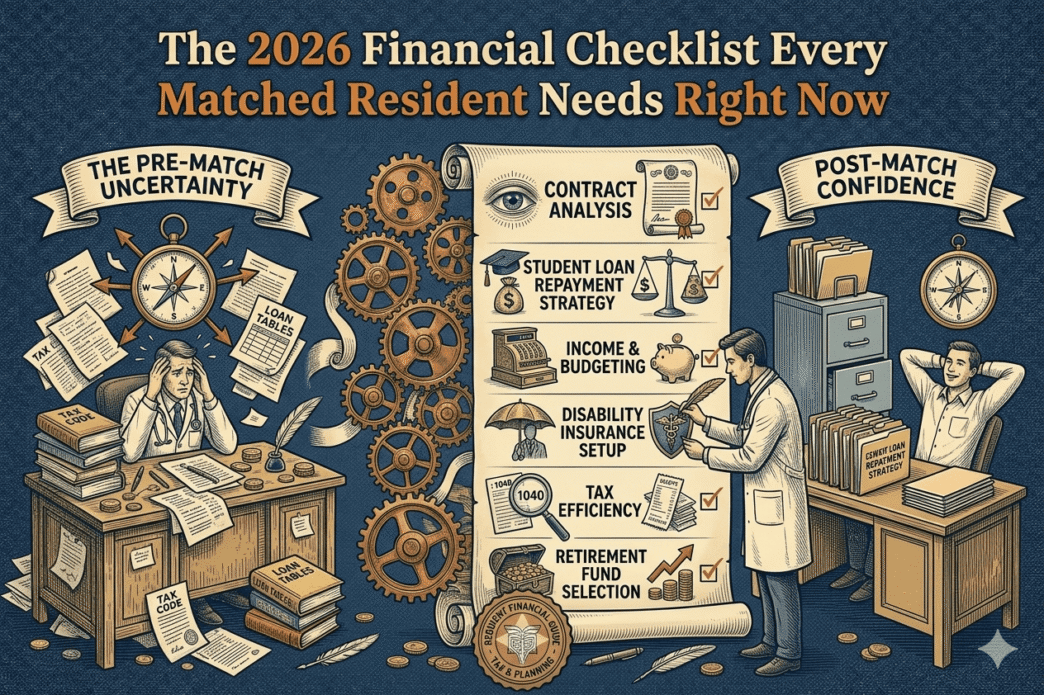
With the emotional rollercoaster of Match Day behind us, let's move on to the financial decisions that need to happen in the next 2 to 3 months before work swallows up your whole life.
The early years of your career in medicine are usually dominated by juggling work and life. So much so that little is said or done about the financial aspect. Yes, residency is hard and you might think “I don't earn nearly enough to be worried about financial planning.”
But you're forgetting that in residency, time (your best friend when it comes to building wealth) is on your side.
The moves you make in the next 60–90 days will set the tone for your entire financial life as a physician. Get them right, and you've built a rock-solid foundation. Ignore them, and you'll spend the next several years playing catch-up.
In case you missed it: 10 Harsh Money Lessons Every PGY-1 Resident Learns the Hard Way
The Numbers You Need to Know First
According to the AAMC, the mean PGY-1 salary as of July 1, 2025 is $68,166. That doesn't sound too bad…until you calculate your actual take-home pay. After federal and state taxes, Social Security, Medicare, and benefits deductions, most residents walk away with somewhere in the ballpark of $3,500–$3,750 per month.
That's what you're actually working with.
Moving on to debt, the median medical school debt for the Class of 2025 was $216,659, and including undergraduate debt, medical school graduates owe approximately $246,659.
If that number makes your stomach drop a little, you're not alone. It's all the more reason to nail down every item on this checklist early.
Despite a 6.5% pay increase reported by Medscape in 2025, many residents say their bills and necessary expenses are so high they can't consistently make ends meet — and when adjusted for inflation, resident salaries from 2020–2024 did not keep pace with the general cost of living in the U.S.
Source: Medscape
So no, you aren't imagining it. The financial pressure during residency is substantial to say the least, and it's exactly why going in with a plan beats winging it.
Our Guide to Tax Savings for Residents
Get a Handle on Your Student Loans — Fast
This is the one that'll keep you up at night if you don't deal with it head-on.
The clock starts ticking the moment you finish med school. Your federal loan grace period will end six months after graduation, which for most matched residents means payments are due right around the time you're adjusting to your sleep deprivation.
You'll want to sort out your repayment strategy before that first bill shows up.
The repayment landscape has changed dramatically
The One Big Beautiful Bill Act has brought sweeping changes to repayment plans, forgiveness rules, and borrowing limits — and doctors need to act now to stay on the most efficient path.
The short version of what's happening is:
- PAYE, SAVE, and ICR plans will sunset by July 2028, with borrowers on those plans transitioned to the new Repayment Assistance Plan (RAP) unless they choose another option.
- On July 1, 2026, the Department of Education officially launches RAP — a new income-driven repayment plan that calculates payments as a percentage of your adjusted gross income, ranging from 1% to 10% depending on your income tier, over a 30-year repayment period.
- SAVE plan interest subsidies ended on August 1, 2025, which affects repayment strategies for physicians with federal student loans.
What does this mean for you as an incoming resident? If you have existing federal loans, your best move right now is to get on an Income–Based Repayment (IBR) plan if you're eligible.
Borrowers pursuing Public Student Loan Forgiveness (PSLF) should consider moving to IBR or PAYE to ensure qualifying months continue to count toward forgiveness.
Learn more about How Much Student Debt Does the Average Doctor Owe? The Ultimate Solution Guide
PSLF Is Still on the Table — For Now
57.6% of 2025 medical school graduates intend to pursue federal student loan forgiveness, and among those, 88.5% plan to apply for PSLF. If you're training at a nonprofit hospital or academic medical center, chances are your employer qualifies.
The good news is that the section in the original One Big Beautiful Bill that would have blocked PSLF for residents and fellows was eliminated, so your residency years still count toward those 120 qualifying payments — at least for current borrowers.
But it's important to keep a weather eye out. PSLF is still subject to political winds. Don't make it your only strategy. Document everything, certify your employment annually, and make sure you're on a qualifying repayment plan.
Read more: PSLF For Doctors: Is It Still Worth It?
What About Refinancing?
Lower interest, yay!
Not so fast. Refinancing your federal loans to a private lender might look tempting — especially if you're quoted a lower interest rate. But the moment you refinance federal loans into private ones, you permanently give up access to income-driven repayment plans and any shot at PSLF. Private loans do not qualify for federal IDR plans or PSLF.
Unless you have exclusively private loans or you've already ruled out public service work, refinancing during residency could be a move you regret down the line. Wait until you have clarity on your long-term career path.
Do this:
- Contact your loan servicer immediately and find out when your first payment is due.
- Determine if you qualify for IBR and apply before the July 1, 2026 RAP transition.
- Certify your employment for PSLF if your employer qualifies.
- Do NOT refinance federal loans without speaking to an advisor who specializes in physician finances.
At Physician on FIRE, we have detailed lender reviews to help your student loan refinancing journey.
Understand Your Employer Benefits Package
For a lot of you, this is your first real W-2 gig. Your residency program is going to hand you a benefits packet that looks like a legal brief, and the temptation is to just pick whatever's default and move on. Don't do that.
Health Insurance
Pick a plan, yes. But understand what you're picking. If your program offers a High Deductible Health Plan (HDHP) paired with a Health Savings Account (HSA), pay close attention — that HSA is a seriously underrated financial tool (more on that later).
For most young, healthy residents, the HDHP/HSA combo often wins due to the benefits alone. Lower premiums plus HSA contributions can beat a higher-premium PPO if you're not running up big medical bills.
Life Insurance and Supplemental Coverage
Your employer almost certainly offers basic life insurance at no cost to you — take it. But be skeptical of the upsell to purchase additional group coverage through the same plan.
Group insurance plans can't discriminate on price between the healthiest 25-year-old and the sickest 60-year-old in the group. Everyone pays a blended rate. As a young, healthy resident, you're subsidizing everyone else. You can almost always get cheaper individual coverage on the open market, and it'll be portable when you leave the program.
Same logic applies to group long-term disability coverage, accidental death and dismemberment, and similar add-ons. Take what's free, evaluate the rest carefully.
Do this:
- Schedule time to read through your full benefits packet before open enrollment closes.
- Compare the HDHP vs. traditional plan using your expected healthcare usage.
- Don't auto-opt into supplemental insurance without pricing individual alternatives.
Learn more: What Types of Insurance Does a Resident Physician Really Need?
Max the Match on Your Retirement Plan
Your residency program offers a retirement plan, probably a 401(k) or 403(b), possibly a 457(b) if you're at certain institutions.
The golden rule you must abide by: Contribute at least enough to get the full employer match. If your program matches 4% of your salary and you contribute less than 4%, you are saying no to free money.
Beyond the match, you'll want to decide between pre-tax (traditional) and Roth contributions. As a resident, your income is probably the lowest it'll ever be as a doctor, which generally makes Roth contributions attractive. You're paying taxes now at a lower rate, and those dollars grow tax-free for decades.
The HSA
If you opt for HDHP, max out your HSA. The 2026 HSA contribution limits are $4,400 for individuals and $8,750 for families, according to the IRS.
This account is triple tax-advantaged. Your contributions go in pre-tax, the money grows tax-free, and withdrawals for qualified medical expenses are tax-free. After age 65, you can use the funds for anything without penalty (you'd just pay ordinary income tax, same as a traditional IRA).
Think of it as a bonus retirement account that also doubles as a medical expense fund. It's one of the best deals in the tax code.
If your institution offers a 457(b), be careful. If it's through a non-governmental (nonprofit) organization, your money is technically a general asset of the employer — meaning if your hospital goes bankrupt, you could lose those funds. Understand what you're getting into before contributing beyond the match.
Do this:
- Confirm your employer's match percentage and contribute at least that amount.
- Decide pre-tax vs. Roth based on your current and expected future tax bracket.
- Open and fund an HSA if you're enrolled in an HDHP.
HSA: The Ultimate Retirement Account
Get Your Own Disability Insurance
This one is non-negotiable.
After spending 8+ years in training, your earning potential as a physician is substantial — sometimes into the millions over a career. Disability insurance is what protects that earning potential if an injury or illness takes you out of the game.
Your employer probably offers some group disability coverage. It's better than nothing, but it almost certainly falls short in two critical ways: it likely only covers a portion of your income, and it's not portable. When you leave your residency program, that coverage disappears.
The Disability Insurance Options No One Tells You About
Own-Occupation Matters More Than You Think
The key phrase to look for is own-occupation coverage. This means that if you can't perform the specific duties of your specialty, you're considered disabled — even if you could technically work in some other capacity.
A surgeon who loses fine motor control should be covered even if they could theoretically work a desk job. That's the protection physicians need.
There are only five insurance companies that offer true own-occupation policies for physicians, so it pays (literally) to work with an independent agent who can shop all five rather than someone tied to one carrier.
Budgeting and Saving During Residency
The Clock Is Working Against You
Insurance rates are based on age and health. Research shows that residents rated their compensation satisfaction at just 5.1 out of 10. 58% of residents in Medcape's survey said that their compensation was less or much less than what they needed.
That financial stress spikes higher when you realize that one bad accident could wipe out your entire earning trajectory without proper coverage.
Source: Medscape
Most carriers offer special resident/fellow discount rates. These policies are typically structured with a small base benefit that you can increase when your attending salary kicks in, without any additional health questions — which is great.
If you develop a health condition during residency, you've already locked in your insurability.
Do this:
- Find an independent insurance agent who specializes in physician disability policies.
- Get quotes from multiple own-occupation carriers.
- Don't rely on group coverage alone. Get an individual policy in place ASAP.
Also read: A Guide to Switching Specialties for Residents
Build Your Emergency Fund Before You Do Anything Else With Extra Cash
An emergency fund is boring, yes. But it's also the foundation that keeps everything else from toppling over.
The goal is to shore up 3–6 months of essential living expenses sitting in a high-yield savings account, liquid and untouched. During residency, you may not get there right away — and that's fine. Start with $500–$1,000 as a buffer, then build from there. Even $100 a month auto-transferred on payday puts you in a completely different position than most of your peers.
Why does this matter so much? Because without a cash cushion, any surprise, like say, your car breaking down, an unavoidable move, or an unexpected medical bill gets put on a credit card. High-interest debt on top of student loan debt during residency is a can you worms you don't want to open.
Where to Keep It
A traditional savings account paying 0.01% interest won't get you anywhere. High-yield savings accounts routinely offer substantially better rates, with no minimum balance requirements and no annual fees. You can use a resource like Bankrate.com to compare current rates across institutions.
These accounts link directly to your checking account, so your money is accessible within a couple of business days if you need it — but it's not so instantly accessible that you could easily dip into it for non-emergencies.
Do this:
- Set up a high-yield savings account.
- Automate a monthly transfer from your checking account on payday.
- Target $1,000 first, then 1 month of expenses, then 3–6 months over time.
Build a Realistic Budget
Does making a budget and sticking to it mean you're being cheap?
Well, so be it.
Budgeting grants you the peace of mind of knowing exactly what you're working with so you can make intentional decisions instead of wondering where all your money went.
For a PGY-1 resident with a gross income of $60,000, your actual take-home pay will likely be around $3,500–$3,750 per month after all deductions. Here's a realistic rough breakdown of what a resident's monthly budget might look like in a mid-cost-of-living city:
| Category | Monthly Estimate |
| Rent + renters insurance | $1,200–$1,600 |
| Utilities + internet | $150–$200 |
| Phone | $50–$80 |
| Transportation (car or transit) | $200–$400 |
| Student loan payment (IDR) | $200–$400 |
| Groceries | $300–$400 |
| Dining out + coffee | $100–$200 |
| Subscriptions + misc. | $50–$100 |
| Emergency fund savings | $100–$200 |
| Total | ~$2,750–$3,580 |
If you're in New York, San Francisco, or Boston, housing alone might chew through $1,800–$2,500. Know your local cost of living before you sign a lease or commit to any fixed expenses.
The 50/30/20 rule (50% to needs, 30% to wants, 20% to savings and debt) gives you a reasonable framework to start with. It won't map perfectly to every resident's situation, but it's a solid starting point that's easy to adjust.
Do this:
- Download a budgeting app (YNAB, Mint, or even a Google Sheet works fine).
- Look up your actual net monthly pay from a pay stub — not your gross salary.
- Check in on your budget at least twice a month until it becomes second nature.
Don't Mess Up a Tried-and-True Path
The financial path for physicians is genuinely one of the clearest routes to long-term wealth that exists. Your attending salary, no matter your specialty, will dwarf your current income. The highest-paid specialties see typical compensation ranging from mid-$500,000s to $600,000 annually, while primary care averages in the high-$200,000 range. Residency income, by comparison, is a chapter. Not the whole book.
Source: Medscape
Can you expect to get rich during residency? Not likely. But you can avoid digging yourself deeper, protect what you've built, and lay the groundwork for the wealth-building that starts when your attending paychecks start rolling in. Is that a lot of pressure? Yes, but it'll be worth it, trust me.
The residents who come out of training in the best financial shape aren't necessarily the ones who sacrificed the most or lived the most austerely. They're the ones who made smart decisions early, got the right insurance and automated savings before they had a chance to spend the money.
Wealth building starts on a resident salary, even with six-figure debt, even while working 60–80 hours a week.
Use this checklist earnestly and you're already ahead of most of your class.
In case you missed it: Medical Residency Match Under Fire: Is It Time For Reform?
Disclaimer: Opinions, reviews, analyses, and recommendations are the author's alone and have not been reviewed, endorsed, or approved by any of these entities. This article is for general educational and informational purposes only. It does not constitute personalized financial, legal, or tax advice. Every physician's financial situation is different. Consult a qualified financial advisor, tax professional, or attorney before making decisions specific to your circumstances.
Frequently Asked Questions
When should I start thinking about my finances after Match Day?
Right now. The six-month grace period on federal loans sounds generous until intern year gets going and you realize three months disappeared. Sort out your repayment plan, benefits enrollment, and insurance before your start date — not after.
Do I really need to worry about finances on a resident salary?
Yes. You're not rolling in cash— yet. But because habits and accounts you set up now will compound over the coming decades. A Roth contribution at 27 is worth a lot more than the same contribution at 37. Time is the one asset you can't buy back.
What happens to my student loans when residency starts?
Your federal loan grace period ends six months after graduation. If you haven't enrolled in a repayment plan by then, your servicer will drop you into the Standard 10-Year plan automatically, which could mean payments in the thousands per month on a resident salary. Get ahead of it.
Is PSLF still worth pursuing in 2026?
It depends on where you're training. If you're at a qualifying nonprofit or academic medical center, yes, it's still worth pursuing, but don't treat it as a sure thing. Certify your employment annually, stay on a qualifying repayment plan, and have a backup strategy in place.
Should I refinance my student loans during residency?
Almost certainly not. Refinancing federal loans into private ones permanently closes the door on income-driven repayment and PSLF. Unless you have strictly private loans already, wait until you know your long-term career path before making a move you can't undo.
What is own-occupation disability insurance and why do residents need it?
Own-occupation coverage means you're considered disabled if you can't perform the duties of your specific specialty, even if you could technically work in some other field. For a physician, that distinction is everything. Only five carriers offer it, and getting covered during residency locks in your insurability at the lowest rates you'll ever see.
What's the difference between a 401(k), 403(b), and 457(b)?
The 401(k) and 403(b) function essentially the same way. The 403(b) is just the version offered by nonprofits and hospitals. The 457(b) is trickier. At a non-governmental organization, your contributions are technically a general asset of the employer. If the institution goes under, so does that money. Contribute to it cautiously, if at all, until you understand your employer's financial footing.
Why is an HSA called a “stealth IRA”?
Because it's triple tax-advantaged — contributions go in pre-tax, growth is tax-free, and withdrawals for medical expenses are tax-free. After 65, you can use the funds for anything and just pay ordinary income tax, same as a traditional IRA. The 2026 limits are $4,400 for individuals and $8,750 for families. If you're on an HDHP, max it out.
How much should I have in an emergency fund as a resident?
The goal is 3–6 months of essential expenses, but don't let that number paralyze you. Start with $500–$1,000. Automate $100 a month into a high-yield savings account and build from there. Something is always better than nothing, especially when you're one car repair away from putting it on a credit card.
Do I need a financial advisor as a resident?
Not necessarily, but it helps to have one who actually specializes in physicians. General advisors often don't understand the nuances of PSLF, own-occupation disability, or the attending income jump. If you do work with one, make sure they're a fiduciary, meaning they're legally required to act in your interest, not earn a commission off your decisions.