





Takeaway: Every goal you set is really just a prediction—of what you want and where your actions will take you. And since we're terrible at predicting the future, maybe it's time we stopped feeling guilty when our predictions need to change. Estimated Reading Time: 2 minutes, 40s.
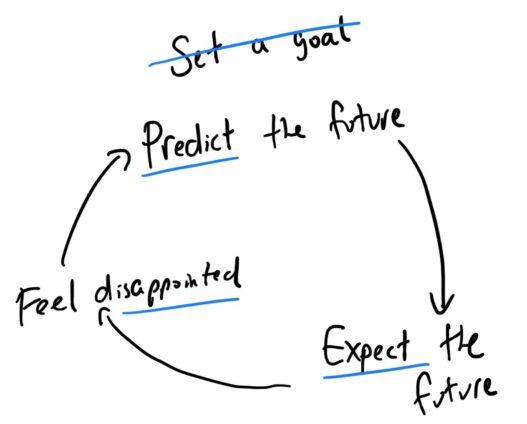
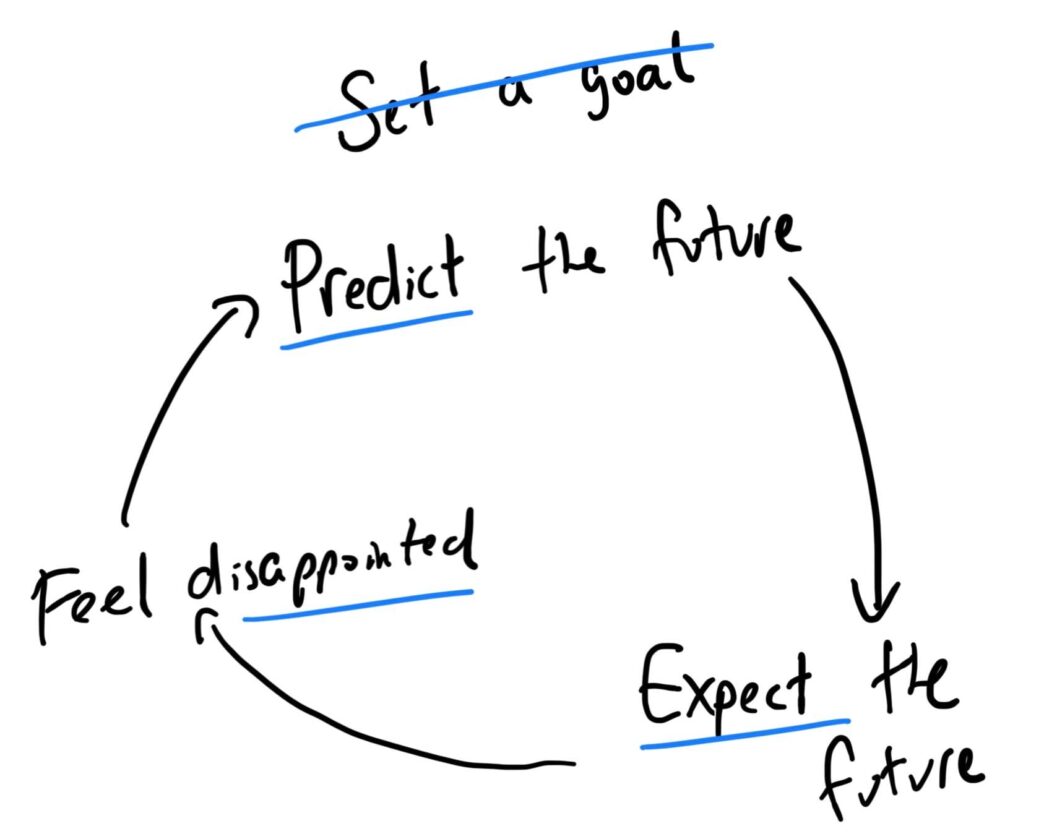
There's a vicious cycle that happens with our goals. We set a goal—which is really just a prediction of what we want. Then, when we inevitably fail to predict the future, we feel guilty and get unnecessarily hard on ourselves.
This is a ridiculous loop when you look at what goals really are: predictions.
Every goal you have is a prediction—of where you believe your current and planned actions will take you. Of course, we're terrible at predicting the future. I don't know what I'll want for dinner tonight—never mind how I'll want to eat across the entire timeline of a goal.
A couple of years ago, as I write about in Intentional, I set a lofty goal to get to 15% body fat. But that goal was a mere prediction of what I wanted. Depending on the context of my day, that isn't always what I actually want! For example, when me or my wife hit a milestone with something, we love going out and celebrating. (And I love a good caloric surplus on celebration nights!)
I also had goals to practice intermittent fasting—if only to balance out the caloric surpluses—while also building some muscle while I was losing fat. The problem was that goals like these didn't work together with one another. They were separate islands that I either would or wouldn't prioritize as the context of my life changed.
And I felt all the ways in which they conflicted. Eating a big meal at the end of a long week conflicted with my fat loss goal, which made me feel guilty about celebrating—when I really had no reason to feel that way.
What fixed my perspective was hearing from a couple of Buddhist monks while writing Intentional. They taught me that goals aren't something we pass or fail—they're a prediction. Of what we want, and of where our actions will take us. And predictions are supposed to be revised.
If you don't believe me, just try predicting the future.
Stepping back, I felt okay about revising my goal. It got me closer to what I wanted. And I made more progress.
My new goal? Create a system where all of my health goals could work together. I wanted the occasional day where I could eat a massive dinner, without regrets or guilt. I wanted to experience the benefits of fasting, but without an overall caloric surplus. I wanted to lose body fat over time, while gaining muscle. I wanted to reward myself for being consistent with my goals.
So the new goal worked great: finding a broader system where all of my smaller goals could work together. (I write about how I did this in Intentional with something I call “habit points.”)
My goals deserved to work together. They were—and still are—all important to me. Your goals deserve to work together too. But also see them for what they are: predictions.