





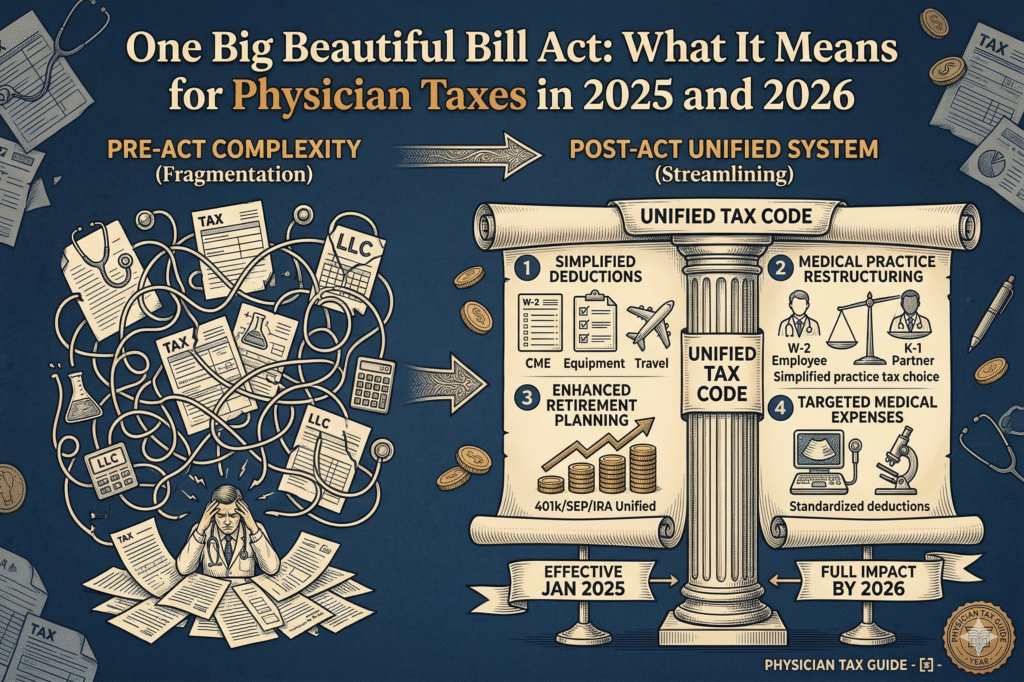
Congress named this one with confidence. The One Big Beautiful Bill, signed into law on July 4, 2025, runs over a thousand pages of tax code changes that most physicians will never read. Fair enough. You have patients to see, charts to finish, and approximately zero free hours.
So here are the parts of the OBBBA that actually matter for physicians during tax season.
Starting with what didn't change: Your individual tax brackets stayed put: 10%, 12%, 22%, 24%, 32%, 35%, and 37%. That last one is yours, almost certainly.
The scheduled rate increases that would have kicked in under the old sunset provisions are gone. You can breathe. Your marginal rate isn't climbing.
The temporary provisions from the Tax Cuts and Jobs Act of 2017, which were set to expire at the end of 2025, are now permanent. For tax year 2025, the OBBB raised the standard deductions to $15,750 for single filers and $31,500 for joint filers.
Now the good stuff, and some of the fine print that will sting if you miss it.
Read: How the One Big Beautiful Bill Act Affects High-Income Taxpayers?
SALT Is Back. Sort Of.
If you own a home in California, New York, New Jersey, or any other high-tax state, the $10,000 SALT deduction cap has been suffocating you since 2017. The OBBBA raises that ceiling to $40,000 for married filers through 2029, with a 1% annual increase each year.
That's not nothing. For a physician household paying $30,000 in state income taxes and another $15,000 in property taxes, this change alone could put real money back into your itemized deductions.
Here's the catch most articles gloss over: the deduction is cut by 30% of the amount by which income exceeds a $500,000 MAGI threshold.
A taxpayer with $550,000 of taxable income would see their maximum SALT deduction of $40,000 shrink by $15,000. The SALT deduction phases out to the old $10,000 maximum at MAGI above $600,000.
So if you're a dual-physician household clearing $700,000 combined, you're basically back to the old cap anyway. Missing this detail is as embarrassing as a surgeon marking the wrong limb before the incision. Run the numbers with your CPA before assuming you'll capture the full benefit.
Another thing to consider is that the OBBB contains no SALT limitation at the entity level. The individual cap and entity-level rules work differently, which is exactly why the pass-through entity tax strategy (more on that later) is valuable for physicians in high-tax states operating through S-corps or partnerships.
SALT for Single Filers
| Filing Status | Max deduction | Phaseout begins | Phaseout complete | Floor (minimum) |
| Single | $40,000 | $500,000 | $600,000 | $10,000 |
| Married filing jointly | $40,000 | $500,000 | $600,000 | $10,000 |
| Head of household | $40,000 | $500,000 | $600,000 | $10,000 |
| Married filing separately | $40,000 | $250,000 | $300,000 | $5,000 |
Caps by filing status
Single Physicians aren't off the hook here either. The $40,000 cap applies to single filers as well as joint filers. It's only those filing as married filing separately who are capped at $20,000.
The complication for single high earners is that the phaseout threshold is the same $500,000 MAGI whether you're filing alone or with a spouse. A single attending earning $600,000 is effectively back to the old $10,000 cap, same as the dual physician household pulling in $1.2 million combined.
The math for the phaseout depends on your filing status, income mix, and state tax burden.
Read our guide to the New Tax Laws and Their Impact on Older Americans
The QBI Deduction: Read the Fine Print
This provision gets the most airtime, and with good reason. The Qualified Business Income deduction of 20% is now permanent, with the phaseout range widened to $150,000 for joint filers, effective 2026.
Now the part nobody wants to tell you: the law continues to exclude certain high-income professional service providers, including physicians, CPAs, and consultants, above the specified income limits.
Medicine is classified as a ‘specified service trade or business' under the tax code. Once your taxable income exceeds the threshold, the deduction phases out entirely. Assuming QBI automatically applies to your clinical income is like a medical student confidently diagnosing a zebra when they haven't ruled out the horse yet.
The tax code, like clinical medicine, punishes overconfidence.
Married physicians filing jointly can claim the full QBI deduction if taxable income stays below $394,600. The deduction phases out between that and $494,600, and disappears entirely above that ceiling. Starting in 2026, this range has widened, with the upper cutoff now at $544,600 for joint filers. While this may be of no use to a dual-income household bringing in $700,000, it's something.
Practice owners with ancillary income, real estate holdings, or management company arrangements structured separately from clinical operations may still capture significant QBI benefits. This is where entity structure becomes genuinely worth the CPA fees.
The OBBB also introduced a $400 minimum deduction for taxpayers with at least $1,000 of QBI, starting in 2026. For smaller pass-through structures that might otherwise get shut out entirely, this is a meaningful floor.
One provision that most physician practice owners haven't heard about is that the OBBBA created a new Section 174A, which restores the ability to fully deduct domestic research and development expenses in the year they're incurred — reversing a painful provision from the 2017 Tax Cuts and Jobs Act that had required those costs to be capitalized and amortized over five years instead.
For practice owners who have invested in developing new clinical protocols, proprietary software, or other qualifying research activities since 2022, there may be real money sitting in prior returns.
Small businesses with average annual gross receipts of $31 million or less can elect to retroactively expense 2022–2024 R&D costs by amending prior returns, but the deadline is July 6, 2026
Learn more about Tax Savings for Physicians
Bonus Depreciation Is 100% Again
This one matters most to physicians who own their practice or any business with meaningful equipment needs. Bonus depreciation had been phasing down: 80% in 2023, 60% in 2024, and was heading toward zero.
The OBBB permanently reinstates 100% bonus depreciation for property acquired and placed in service after January 19, 2025.
Buy a $200,000 piece of diagnostic equipment, place it in service this year, deduct the full $200,000.
Not over seven years. Now. Waiting on this one is about as sensible as a radiologist refusing to read a STAT CT because the paperwork isn't perfect. The opportunity is sitting right there. Use it. Section 179 expensing limits also jumped to $2.5 million, with phaseouts beginning at $4 million in total qualifying purchases.
It's worth noting that bonus depreciation and Section 179 elections reduce your reported QBI. Aggressively depreciating equipment in a given year can push your QBI number down, cutting your deduction. Talk to your advisor before placing equipment in service so you don't miss out on either one.
HSAs Got Significantly Better
This gap deserves more attention than it gets. The OBBB expands the availability of Health Savings Accounts, including allowing telehealth and other remote care services to be received before meeting a high-deductible health plan deductible.
Physicians and high-income earners benefit from expanded HSA eligibility and higher income thresholds for tax-deductible medical expenses.
For a physician maxing an HSA, the triple tax advantage remains one of the cleanest moves in the entire tax code: pre-tax contributions, tax-free growth, tax-free withdrawals for qualified medical expenses.
Not maxing your HSA every year and investing those funds rather than spending them is the financial equivalent of prescribing antibiotics for a viral infection. You're not helping anyone, and it's going to cost you.
The OBBB also treats individual market bronze and catastrophic plans as HSA-eligible HDHPs. For locum tenens physicians, or anyone between hospital jobs with flexibility in choosing coverage, this provides more HSA eligibility than before.
Learn more: HSA: The Ultimate Retirement Account
The estate tax exemption has increased to $15 million per person, meaning high-net-worth physicians can now pass up to $30 million for jointly filing spouses, indexed for inflation beginning in 2026, without incurring federal estate tax.
If you've been putting off conversations with an estate attorney, the window is wide open. Gifting strategies, irrevocable trusts, and family limited partnerships all become more valuable with this much headroom.
Ignoring estate planning at this income level is like an internist skipping the medication reconciliation on a complex admit. One day it's fine. Eventually it isn't.
You can now use up to $20,000 per year from a 529 plan for K-12 expenses, and the plan now includes books, online materials, tutoring, standardized tests, homeschooling, and special education therapy. For physicians with school-age children in private schools or those who homeschool, this is a meaningful expansion. Think of it as preventive care for your family's balance sheet.
How to Fund a 529 Plan: A Complete Guide for Physicians and Families
Trump Accounts
Worth mentioning because you'll hear about them. New parents are now eligible to receive a $1,000 government-funded seed contribution into a ‘Trump Account' for newborn children born between 2025 and 2028, invested in a low-cost U.S. index fund until the child turns 18.
Parents can contribute up to $5,000 annually into these accounts.
Think of it as a long-acting medication with excellent adherence. You set it, you forget it, and by the time your kid is heading to college, the compounding has done work you barely noticed.
Employers can contribute up to $2,500 per year toward an employee's account without it counting as taxable income. For practice owners, this can be a low-cost recruiting and retention perk at a time when support staff turnover is one of the more expensive operational headaches in clinical medicine.
Are Trump Accounts the Trump Card America Needs? OBBBA and the Baby Bonus
Auto Loan Interest Deduction
A new one most people haven't heard about. Effective 2025 through 2028, individuals may deduct interest paid on a loan used to purchase a new qualified vehicle for personal use, with a maximum annual deduction of $10,000.
The deduction phases out for taxpayers with MAGI over $100,000 ($200,000 for joint filers).
The income phaseout is aggressive enough that most attending physicians won't capture much of this one. Counting on this deduction at a $400,000 income is like a cardiologist ordering a stress test on a 25-year-old marathon runner. Technically possible. Practically not very useful.
In case you missed it: Life In The Fast Lane: Best Cars for Doctors
The Pass-Through Entity Tax is a state-level strategy designed to help S-corps, partnerships, and LLCs mitigate the impact of the federal SALT deduction cap. A lot of physicians in high-tax states still aren't using their state's PTET election, which effectively lets the entity pay state income taxes at the business level and deduct them without touching the individual SALT cap.
Not using the PTET when it's available is as painful to watch as a hospitalist refusing to consult a specialist when the answer is sitting right there.
For qualifying small businesses under the $31 million gross receipts threshold, the employer-provided child-care credit expanded to 40% of qualified expenses, up to $500,000 annually (50% for eligible small businesses, up to $600,000). Dependent Care FSA limits also rose to $7,500. Staffing a medical practice these days sometimes feels like running a trauma bay short-handed during a holiday weekend. These benefits are recruitment advantages, not just tax breaks.
The OBBB delivered genuinely bad news on this front, and any article aimed at physicians that skips it is incomplete.
The legislation caps the amount of federal loans students can borrow for professional programs, such as medical, dental, or law school, at $50,000 per year with a total lifetime limit of $200,000, and eliminates the Grad PLUS loan program entirely for new borrowers starting July 1, 2026.
The median cost of attending a private medical school is $390,848, and the median debt load for the medical school class of 2024 was already $205,000, according to AAMC data. The math simply doesn't work.
Students who need more than the federal cap covers will turn to private loans, which carry higher interest rates, stricter credit requirements, and none of the income-driven repayment protections that federal loans provide.
Watching medical students navigate this new environment is about as stressful as an emergency physician running a full waiting room during a flu surge with two nurses out sick.
AAMC President David J. Skorton, MD warned that eliminating or restricting these critical programs would undermine the future physician workforce and ultimately make it harder for patients in communities nationwide to get the care they need.
If you have residents, fellows, or medical students in your life, this is worth discussing.
In case you missed it: How Much Student Debt Does the Average Doctor Owe? The Ultimate Solution Guide
The new bill allows the ACA to revert back to a subsidy cliff in which earning one dollar of income over a threshold eliminates all healthcare subsidies.
For physicians who own practices with significant Medicaid patient populations, or those in emergency medicine or obstetrics where EMTALA applies, this isn't just a political abstraction. A cardiologist placing a stent on an uninsured patient doesn't make the bill disappear. It just moves who absorbs the loss.
The Congressional Budget Office projects that this new law will increase the number of people without health insurance by approximately 10 million by 2024. That number will jump to 14–16 million if the ACA's enhanced premium tax credits are not extended.
Work requirements for Medicaid expansion enrollees take effect gradually before January 2027. Provider tax freezes starting in late 2026 will limit how states finance their share of costs, squeezing Medicaid reimbursement (which is already thin) further. AMA's Annalia Michelman described the combined marketplace and Medicaid changes as a “perfect storm” wherein multiple policy changes have converged to make coverage simultaneously harder to obtain and maintain.
The $50 billion Rural Health Transformation Fund provides some relief for rural hospitals facing the sharpest Medicaid exposure. But 44% of rural hospitals were already running negative margins before the OBBB took effect. And a 5-year fund will not be able to fix a structural financing problem.
None of this is useful as abstract information.
The QBI deduction is only valuable if your entity structure is optimized for it. Bonus depreciation only helps if you time your purchases correctly. The SALT expansion only applies if you can itemize, and only partially if your income exceeds $500,000.
Showing up to your accountant in April with a stack of disorganized documents is like a patient showing up to the clinic for a complex follow-up without their medication list, their labs, or any memory of what was discussed last time.
The physicians who benefit most from legislation like this are the ones who act in January and February.
Pull together your 2024 returns, your practice's financials, and a list of capital purchases you've been considering.
Ask specifically about QBI eligibility given your specialty and income level, equipment timing for bonus depreciation, whether the retroactive R&D election applies before the July 4, 2026, deadline, and whether your state's PTET election is being fully utilized.
Having many of the tax rules made permanent does simplify planning and offers stability after years of expiration dates looming overhead. That said, ‘permanent' here only means the rules won't change on their own. Congress could rewrite the tax code again in the future.
Plan as if the rules are real today. Because they are. And because doing nothing is its own kind of decision, with its own kind of consequences. Ask any physician who's watched a patient defer a colonoscopy for five years. Waiting is always a choice.
In case you missed it: The Overlooked Investment Every Doctor Should Use to Cut Taxes and Lower Risk
Frequently Asked Questions: The One Big Beautiful Bill and Physician Taxes
Does the QBI deduction apply to physicians?
It depends on your income. Medicine is classified as a “specified service trade or business,” which means the 20% QBI deduction phases out once taxable income exceeds certain thresholds. For joint filers in 2025, the deduction is fully available below $394,600, phases out between $394,600 and $494,600, and disappears entirely above that. Starting in 2026, the upper cutoff rises to $544,600 for joint filers. Physicians with ancillary income streams or separately structured management entities may still capture partial or full QBI benefits regardless of clinical income — this is where entity structure matters most.
What is the SALT deduction cap under the One Big Beautiful Bill?
The OBBBA raises the federal cap on state and local tax deductions from $10,000 to $40,000 for tax years 2025 through 2029, with a 1% annual increase each year. The cap applies equally to single and joint filers; married filing separately is capped at $20,000. However, the deduction phases out for taxpayers with MAGI above $500,000, and reverts entirely to the old $10,000 limit in 2030. High-income physicians in states like California, New York, and New Jersey may see limited or no benefit once the phaseout applies.
Is 100% bonus depreciation permanent under the new law?
Yes. The OBBBA permanently reinstates 100% bonus depreciation for qualifying property acquired and placed in service after January 2025, reversing the phasedown that had reduced it to 60% in 2024. Physician practice owners can now deduct the full cost of eligible equipment in the year it's placed in service rather than depreciating it over several years. Section 179 expensing limits also increased to $2.5 million. One important caveat: bonus depreciation reduces your reported QBI, so aggressive equipment expensing in a given year can reduce or eliminate your QBI deduction. Coordinate both with your advisor before year-end.
How does the One Big Beautiful Bill affect physician student loan borrowing?
The news here is negative. Starting July 1, 2026, the OBBBA caps federal graduate loan borrowing for professional programs — including medical school — at $50,000 per year with a lifetime limit of $200,000, and eliminates the Grad PLUS loan program entirely for new borrowers. Given that the median cost of attending a private medical school already exceeds $390,000, students who need additional funding will have to turn to private loans, which carry higher interest rates and none of the income-driven repayment protections of federal loans.
What happened to the estate tax exemption?
The OBBBA raised the federal estate tax exemption to $15 million per individual — $30 million for married couples — indexed for inflation beginning in 2026. For high-net-worth physicians, this significantly widens the window for gifting strategies, irrevocable trusts, and family limited partnerships before any federal estate tax applies.
Are HSAs more accessible under the new law?
Yes, in two meaningful ways. The OBBBA allows telehealth and remote care services to be received before meeting a high-deductible health plan deductible without losing HSA eligibility, and it treats individual market bronze and catastrophic plans as HSA-eligible HDHPs. For locum tenens physicians or anyone between employer plans, this expands HSA eligibility to coverage types that previously didn't qualify. The triple tax advantage — pre-tax contributions, tax-free growth, and tax-free withdrawals for qualified medical expenses — remains fully intact.
This article is for informational purposes only and does not constitute tax or legal advice. Consult a qualified tax professional for guidance specific to your situation.
References
- Internal Revenue Service. (2025). One, Big, Beautiful Bill provisions. IRS Newsroom.
https://www.irs.gov/newsroom/one-big-beautiful-bill-provisions
- Internal Revenue Service. (2025). One, Big, Beautiful Bill Act: Tax deductions for working Americans and seniors. IRS Newsroom.
https://www.irs.gov/newsroom/one-big-beautiful-bill-act-tax-deductions-for-working-americans-and-seniors
- TurboTax / Intuit. (2025). Taxes 2025-2026: One Big Beautiful Bill Act tax law changes and how that impacts you.
https://turbotax.intuit.com/tax-tips/general/taxes-2021-7-upcoming-tax-law-changes/L3xFucBvV
- H&R Block. (2025, November 21). One Big Beautiful Bill tax changes: How and when they impact you.
https://www.hrblock.com/tax-center/irs/tax-law-and-policy/one-big-beautiful-bill-taxes/
- Gilpin Givhan, PC. (2025). Major tax changes for businesses in the One Big, Beautiful Bill Act of 2025.
https://gilpingivhan.com/insights/articles/major-tax-changes-for-businesses-in-the-one-big-beautiful-bill-act-of-2025
- Charles Schwab. (2025). One Big Beautiful Bill Act tax cuts.
https://www.schwab.com/learn/story/one-big-beautiful-bill-act-tax-cuts
- Cain Watters Blog. (2025, July 9). The One Big Beautiful Bill: Key tax changes for 2025 and beyond.
The One Big Beautiful Bill: Key Tax Changes for 2025 and Beyond
- Medical Economics. (2026, January 17). The One Big Beautiful Bill and effect on estate and tax planning for physicians.
https://www.medicaleconomics.com/view/the-one-big-beautiful-bill-and-effect-on-estate-and-tax-planning-for-physicians
- NBC News. (2025, July 9). Medical students fret over the new student loan cap in the “big, beautiful bill.” [Pettypiece, S.]
https://www.nbcnews.com/politics/congress/medical-students-fret-student-loan-cap-big-beautiful-bill-rcna217228
- Association of American Medical Colleges (AAMC). (2025, June 25). Proposed changes to federal student loans could worsen the doctor shortage.
https://www.aamc.org/news/proposed-changes-federal-student-loans-could-worsen-doctor-shortage
- Center for American Progress. (2025, December 16). 7 ways the Big Beautiful Bill cuts taxes for the rich.
- Student Doctor Network. (2025, August 12). The “One Big Beautiful Bill”: How new budget legislation may reshape medical training and healthcare access.
- Hensley CPA Firm. (2025). The One Big Beautiful Bill: What small business owners need to know for 2026. Client newsletter.
- Barnes Dennig CPAs. (2025, July 10). How the 2025 One Big Beautiful Bill Act changes the Qualified Business Income deduction. [Curdes, W.]
How the 2025 One Big Beautiful Bill Act Changes the Qualified Business Income Deduction