




Hat Yai wasn't supposed to be a destination for me.
Most travellers to southern Thailand fly over it on the way to Phuket, or pass through it on an overnight bus to Krabi without stopping. The ones who do stop usually spend a night, eat some fried chicken, and move on.
I was one of those people, until Tourism Authority of Thailand invited me on a media trip through Hat Yai and Songkhla, and I realised I'd been completely wrong about what this city actually offers.
Hat Yai is Thailand's third-largest city, sits forty minutes from the Malaysian border, and has a character that doesn't fit neatly into the usual southern Thailand narrative.
It isn't a beach town.
It isn't a party island.
It's a proper city with real markets, genuinely good food, a local Muslim-Thai-Chinese cultural blend you won't find anywhere else in the country, and a surrounding region — Songkhla, Satun, Koh Lipe, that most international travellers overlook entirely.
I spent 6 days moving through Hat Yai, Songkhla Old Town, and all the way south to Koh Lipe, and what struck me most was how little of it appears in mainstream Thailand travel content. This article is my attempt to fix that.
Before You Go: Sort Your eSIM
Hat Yai is close to the Malaysian border, and the network situation can get confusing if you're not prepared — your phone may try to roam onto Malaysian networks depending on where you are in the city.
An eSIM sorted before you fly saves you the hassle entirely. I used it throughout the trip for navigation between Hat Yai, Songkhla, and Satun, and coverage stayed solid the entire way. Check out my guide to the best eSIM for Thailand before you travel — it's worth the 5 minutes.
10 Things You Can't Miss In Hat Yai, Thailand
1. Eat Hat Yai Fried Chicken At Kai Tod Decha
Every city in Thailand has its dish. Hat Yai's fried chicken is different from fried chicken anywhere else.
Hat Yai-style fried chicken — kai tod hat yai — is marinated with shallots, garlic, and turmeric before frying, which gives it a distinctly golden colour and a depth of flavour that the plain crispy versions elsewhere don't have. It's served with crispy fried shallots on top and a sticky-sweet sauce on the side. The skin shatters. The meat stays juicy.
Kai Tod Decha is where you go. It's been doing this for decades, the queue tells you everything you need to know before you've even seen the menu, and lunch there on day 1 of our trip set the tone for everything that followed.
Order the half chicken, get extra shallots, and eat it immediately while it's still hot.
This is the meal Hat Yai is famous for across Thailand. Don't treat it as a side note.
Location
2. Take The Cable Car To Khao Kho Hong
Cable Car, Hat Yai, Thailand
The hill sits within Khao Kho Hong Botanical Garden, which feels completely detached from the city below it — quiet trails, shade, the sound of birds rather than traffic.
At the top, alongside the viewpoint, there's a large reclining Buddha and several smaller temple structures that most visitors walk past quickly on their way to take the photo. Legend has it that if you make your wishes with the Buddha, they'll come true. Let's see how my prayers turn out!
We went around 4:30 pm, which turned out to be ideal.
- Ticket price: ~THB 200 / USD 5.70 (round trip)
- Wait time: ~15 minutes
The ride itself is short, but at the top you'll find:
- A large reclining Buddha
- Smaller temple structures
- Open viewpoints facing the city
What I didn't expect was how quiet it felt.
Compared to places like Phuket viewpoints, this wasn't crowded. We had long stretches where it was just a few locals and us.
Standing up there watching Hat Yai spread out toward the Malaysian border in the distance, with almost no one else around, was one of those moments that feels disproportionately significant for something that wasn't even on my radar before the trip.
Go at 4 pm. Stay until the light goes.
Location
3. Spend A Morning In Songkhla Old Town
Songkhla doesn't get its own articles. It gets mentioned as a day trip from Hat Yai, treated as a footnote, and then forgotten. That's a mistake.
Songkhla Old Town is one of the most visually distinctive places I visited in Thailand — a Sino-Portuguese shophouse district with the same architectural bones as Penang or George Town, but without a fraction of the tourist infrastructure.
Street art appears on building corners without signage directing you to it. Cafés exist inside renovated colonial buildings with almost no online presence. You find them by walking.
We spent a morning moving through the old town slowly, stopping at a corner café that had maybe 4 tables and the best Thai iced coffee I had on the entire trip. The owner spoke minimal English, pointed at things on the menu with a smile, and brought us food we hadn't ordered that turned out to be exactly right.
Arrive before 9 am to beat the heat. The streets are quiet, the light is flat and beautiful, and the town belongs to the people who live there rather than the people visiting it.
Location
4. See the Mermaid Statue at Samila Beach
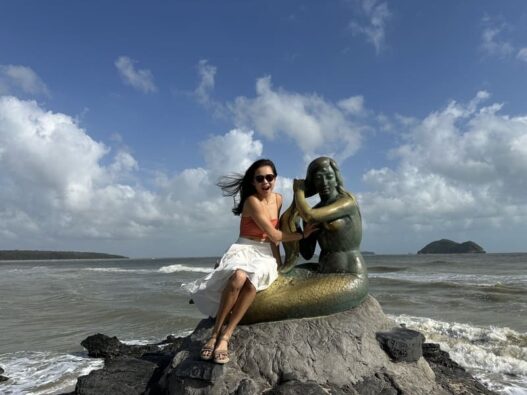
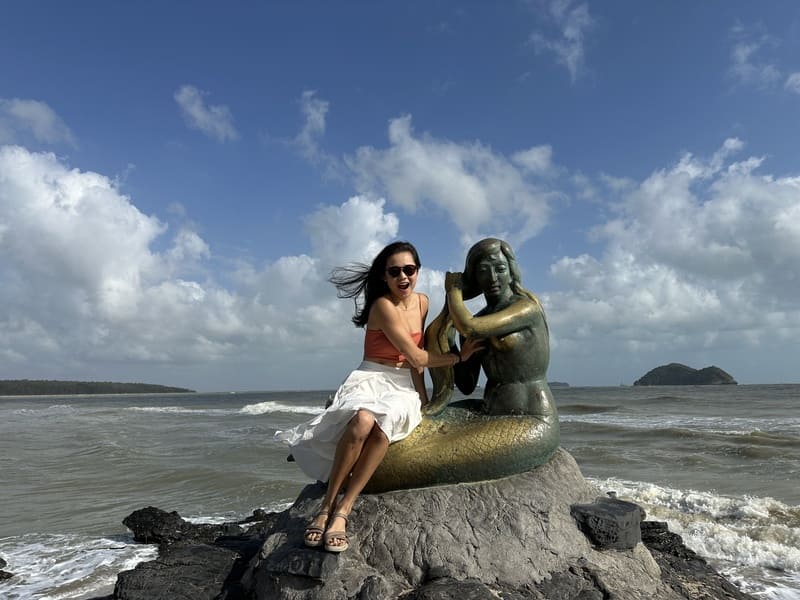
The golden mermaid statue at Samila Beach is Hat Yai's most photographed landmark and appears in every must-do list in Hat Yai. It's worth seeing. It's also worth walking past it.
Samila Beach stretches north from the statue along the edge of the Gulf of Thailand, and once you're 30 seconds past the tourist congregation around the mermaid, the beach is almost completely empty.
Mermaid Statue at Hat Yai, Thailand
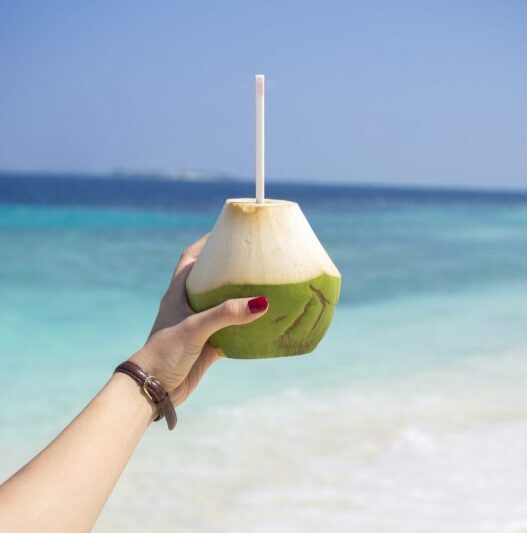
Local families set up on weekends. A few fishermen work the shallows in the early morning. Vendors sell coconuts from the back of motorbikes.
The beach itself is not a swimming beach — the water is murky, and the shore is flat — but as a place to walk in the early morning before the heat arrives, it's genuinely beautiful.
Location
5. Visit Hat Yai's Night Markets And Walking Streets
Hat Yai has multiple night markets.
The main Santisuk Night Market is the largest and most tourist-facing — good for grilled meats, fresh fruit, and getting your bearings on Thai street food prices. But the smaller walking streets in the Niphat Uthit area are where the local food culture actually lives.
Stalls that have been operating in the same spot for 20 years. Muslim-Thai food sits alongside Chinese barbecue and Thai dessert vendors. A food culture that reflects the city's actual demographic rather than what it thinks visitors want to eat.
Go after 8 pm when it's fully operational, eat as many things as possible in small portions rather than committing to 1 stall, and follow the queues rather than the English-language signage.
6. Take The Boat To Koh Lipe
Koh Lipe sits at the southern tip of Thailand, 40 minutes by boat from Pak Bara Pier in Satun, and it's one of those islands that people describe as paradise without sounding like they're exaggerating.
The journey from Hat Yai to Pak Bara takes around 2 hours by road, which puts most people off. Don't let it. The island on the other side of that drive has water so clear you can see the bottom in 15 metres of it, coral reefs close enough to shore that you don't need a boat to snorkel, and a walking street that functions like a proper village rather than a tourist corridor.
We stayed at Bundhaya Resort on Pattaya Beach, and the experience of waking up to that water every morning reset something in my brain that city travel had worn down. There's no ATM on the island — bring cash from Hat Yai.
The pace is determined by the tides and the sun rather than any schedule, and after 2 days of that, it becomes impossible to imagine why you'd rush it.
The snorkelling around the surrounding islands — Koh Adang, Koh Rawi, Koh Jabang — covers some of the best reefs in the Andaman Sea. We spent a full day island hopping between snorkelling spots and came back sunburned and completely satisfied in a way that planned activities rarely produce.
Location
7. Do the Batik Painting Workshop In Satun
On the way back from Koh Lipe, we stopped in Satun for a batik painting workshop at Punya Batik, and it was the part of the trip I expected least and remembered most.
Batik is a wax-resist fabric dyeing technique with deep roots in southern Thailand and Malaysia, and Satun's version uses fossil patterns specific to the region.
The instructor walked us through the process without pressure or expectation, and there was something about sitting quietly with a brush and cloth, making deliberate, small decisions, that cleared the head in a way that sightseeing doesn't.
I'm not crafty. My finished piece was imperfect in multiple specific ways. I kept it anyway, and it's one of the few physical objects I brought back from the trip that actually means something.
8. Eat Dim Sum At Timsum Chookdee for Breakfast
On our final morning, we had breakfast at Timsum Chookdee — a local dim sum institution that has been operating in Hat Yai long enough to have regulars who've been coming for thirty years. What was refreshing was how the dimsum is offered almost like a buffet – you pick what you want, and they steam it for you.
Hat Yai's Chinese heritage means the dim sum culture here is genuine rather than adapted for tourists. Har gow with properly thin skin. Siu mai that hasn't been compromised. Turnip cake is fried until the edges are crisp. Chrysanthemum tea served in the old-fashioned way with a constant refill from a server who moves through the room with the efficiency of someone who has done this 10 thousand times.
Dim Sum, Hat Yai, Thailand
It opens at 6 am and can be full by 7 am. Order the classic dishes rather than anything unfamiliar — the classics are what it's known for, and they earn the reputation.
Location
9. Stay In Songkhla Lake's Scenic Viewpoints
Songkhla Lake is the largest natural lake in Thailand and one of the least talked-about landscapes in the south.
It sits between Hat Yai and the coast, ringed by fishing villages, and the viewpoints along its western edge at late afternoon are the kind of scene that makes you put the camera down because you can't capture it properly anyway.
We drove the lake road back from Songkhla Old Town as the sun was dropping, and the quality of light on the water — flat, silver, with fishing boats silhouetted against it — was one of the most visually striking things I encountered on the entire trip. It appears in almost no travel content about the region because there's nothing to do there except look. That's precisely the point.
10. Visit the Magic 3D Museum
This wasn't something I would have planned on my own, but it was part of the itinerary on our first day — and it ended up being a fun, low-effort stop between other activities.
We visited the Magic 3D Museum Hat Yai in the afternoon, just before heading up to Khao Kho Hong. Entry was around THB 300 / USD 8.50, and the experience is exactly what it sounds like — optical illusion rooms, painted backdrops, and interactive installations designed for photos.
What made it work was the timing.
After a morning of travel and lunch, it was an easy, air-conditioned break from the heat. We spent about 45 minutes to 1 hour walking through different themed rooms — underwater scenes, fantasy setups, and perspective illusions where you need to position yourself properly to get the effect.
It's not a must-do in the same way as food or Songkhla, but it serves a purpose:
- Good break from the humidity
- Easy activity if you arrive early in Hat Yai
- Works well if you're travelling with family or on content-focused trips
Tip:
Pair this with the Hat Yai Cable Car since they're in the same area. It makes more sense as part of a half-day plan rather than a standalone visit.
Location
Where To Stay In Hat Yai, Thailand
W3 Hotel
W3 Hotel Room, Hat Yai, Thailand
This is where we stayed on our first night in Hat Yai, and it worked really well as an introduction to the city.
W3 Hotel Hat Yai is located just off Rajyindee Road, about 5–10 minutes by Grab (THB 60–80 / USD 1.70–2.30) to the main market areas like Niphat Uthit and Santisuk. If you're comfortable walking, it's around 15–20 minutes, though it can feel longer in the heat.
Room-wise:
- Clean, modern, slightly boutique feel
- Good air-conditioning (important in Hat Yai)
- Fast WiFi — stable enough for work and uploads
- Rooms are on the smaller side but well-designed
Price range during our stay:
- Around THB 1,200–1,800 / USD 34–51 per night
What I liked:
- Quiet at night despite being central
- Easy access to food and markets
- Smooth check-in and generally efficient service
What to note:
- Not directly inside the main market zone (you'll still need short transport)
- Limited facilities (no gym or full-service amenities)
Best for:
First-time visitors who want a clean, central base without being in the middle of the noise.
Monkham Hotel
Monkham Hotel, Hat Yai, Thailand
We stayed at Monkham Village Hat Yai after returning from Koh Lipe, and the difference was noticeable — it feels more like a resort-style hotel compared to W3.
Location-wise, it's slightly further out:
- About 10–15 minutes to the city centre (THB 80–120 / USD 2.30–3.40 by Grab)
- Around 15–20 minutes to Hat Yai Airport, depending on traffic
Room and facilities:
- Larger rooms with more space to unpack
- Pool area and more relaxed layout
- Overall quieter and less “city-like”
Price range:
- Around THB 1,500–2,500 / USD 43–70 per night
What I liked:
- More comfortable after a long trip (especially coming back from Koh Lipe)
- Better for resting rather than exploring
- Easier logistics for early flights
What to note:
- Not walkable to markets or main attractions
- You'll rely on Grab for most movements
Best for:
- Last night before flying out
- Prioritising comfort over location
How To Get To Hat Yai, Thailand
The most convenient option from Singapore is a direct flight with Scoot, the route takes around an hour and 20 minutes and runs multiple times daily.
From Bangkok, domestic flights with AirAsia or Thai Lion Air take around an hour and 30 minutes.
Buses from Kuala Lumpur and Penang are also a well-travelled option for overland travel from Malaysia.
Best Time To Visit Hat Yai, Thailand
November to February is the sweet spot — cooler temperatures, lower humidity, and the end of the monsoon season.
March to May brings increasing heat.
June to October is monsoon season in the south, which affects Koh Lipe access specifically — speedboats don't run in rough conditions, and the island effectively closes for the low season.
If Koh Lipe is part of your plan, November to April is the window. Plan around that first, and everything else will fall into place around it.
Hat Yai doesn't ask for your attention the way the obvious Thailand destinations do. It doesn't have a famous beach or a landmark that appears on every mood board.
What it has is a city that works — genuinely good food, a cultural texture that comes from being a real place rather than a constructed tourist experience, and a surrounding region that contains some of the most underrated landscapes in southern Thailand.
Give it more than a night. It earns it.
FAQs About Hat Yai, Thailand
What to do in Hat Yai for 3 days?
For a 3-day itinerary in Hat Yai, I'd split it between the city and nearby areas. Day 1 can be spent exploring Hat Yai itself — fried chicken spots, night markets, and the cable car at Khao Kho Hong. Day 2 is best for a half or full-day trip to Songkhla Old Town and Samila Beach. On Day 3, you can either slow down with cafés and local food or take it further with a trip toward Satun or even start your journey to Koh Lipe. 3 days gives you enough time to experience both the city and what makes this region unique.
What are the best things to do in Hat Yai at night?
Hat Yai comes alive at night, especially around the Niphat Uthit area and Santisuk Night Market. This is where you'll find the best street food — grilled meats, local desserts, and Muslim-Thai dishes you won't see in other parts of Thailand. Walking through the markets, trying small portions, and following the busiest stalls is honestly the highlight. If you're not into markets, there are also late-night cafés and massage spots open until midnight.
What are the best things to do in Hat Yai with kids?
If you're visiting Hat Yai with kids, there are a few easy options that work well. The Magic 3D Museum is interactive and fun for photos, while the Hat Yai Cable Car gives a short, scenic ride without being too tiring. You can also head to Samila Beach for a relaxed walk or let them try different snacks at the night markets. Most activities are low-effort, which makes it a surprisingly easy destination for families.
Is Hat Yai safe for travellers?
Hat Yai is generally safe for travellers, including solo visitors and families. It's a busy commercial city, so common sense applies — keep an eye on your belongings in crowded markets and avoid quiet areas late at night. During my trip, I didn't experience any safety issues, even walking around at night. The main thing to be aware of is traffic rather than crime — crossing roads can feel chaotic at first. Overall, it feels safe, especially in central areas and tourist zones.